
Truck plunges off Ngezi Bridge after near head-on crash scare
 By Rebecca Zimera3 min read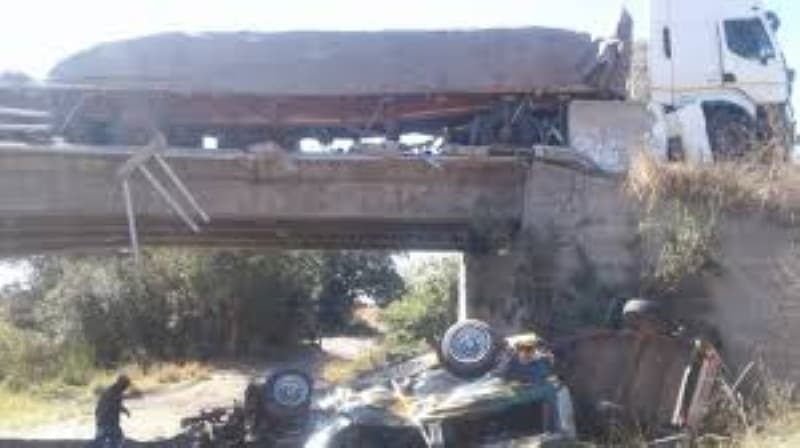
A haulage truck plunged off Ngezi Bridge and into the river below after a near head-on crash scare, renewing scrutiny of one of Zimbabwe’s most feared danger spots for heavy vehicles.
The incident, which was captured in widely shared footage and described by eyewitnesses, happened near Zvishavane on April 11. Early accounts suggest the truck veered wildly as it approached the narrow bridge before crashing through the barriers and falling into the Ngezi River. What remains unclear is which part of the chain of events triggered the loss of control, but the bridge’s history is already doing part of the story’s work: this is not a random location, and this is not the first time a chrome-laden truck has gone over the edge there.
Ngezi Bridge has developed a grim reputation among drivers and transporters because of repeated crashes involving heavy vehicles. That pattern matters more than any single dramatic video clip.
A near collision appears to have turned into a plunge
Preliminary reports and eyewitness accounts suggest two chrome-laden haulage trucks were travelling from Mberengwa towards Zvishavane when the lead vehicle began zigzagging near the bridge.
According to early accounts, the driver may have been temporarily blinded by bright headlights from an oncoming Isuzu truck. Reports also indicate that a kombi had stopped on or near the bridge, forcing sudden evasive action as the haulage truck tried to avoid a direct collision.
That sequence has not yet been fully verified by authorities. But the reported combination of blinding lights, a narrow bridge and a stationary vehicle points to something more than simple driver error.
Ngezi Bridge is no longer just an accident scene but a repeated warning
This is where the story becomes bigger than one crash.
Local reports and social media discussions have repeatedly identified Ngezi Bridge as a danger zone for heavy trucks. In October 2025, two chrome-loaded haulage trucks also reportedly plunged into the Ngezi River after trying to avoid a stationary vehicle on the bridge.
That recurring pattern raises an uncomfortable question: if the same type of crash keeps happening at the same location, the problem cannot be written off as isolated misfortune. It points to a structural road safety failure, whether in bridge design, visibility, hazard management, enforcement or all four at once.
Zimbabwe’s road safety crisis is deepening beyond one bridge
The plunge comes days after another road tragedy shocked the country, when six members of the same family were killed in a head-on collision on the Harare-Masvingo highway near Mvuma.
That earlier crash intensified public grief and renewed debate over Zimbabwe’s road safety failures. Taken together, the Mvuma deaths and the Ngezi Bridge plunge show how quickly ordinary travel on known danger routes can turn fatal.
The broader trend is also worsening. During the 2026 Easter holiday, 30 people died in road accidents, up from 24 during the same period in 2025, even though the total number of recorded accidents fell. That suggests not just frequent crashes, but more severe ones.
The real issue is not just driver behaviour
Road authorities and traffic experts often point to speeding, fatigue, mechanical faults and dangerous overtaking. Those factors matter, but they do not explain recurring crashes at the same bridge if the route itself keeps amplifying risk.
At Ngezi Bridge, the reported role of bright headlights, a stopped vehicle and narrow crossing conditions highlights a broader problem. Drivers are being asked to manage high-risk infrastructure with too little margin for error.
The question now is why a known danger point still behaves like a trap
If authorities already know Ngezi Bridge is a repeat crash site for haulage trucks, then the issue is no longer whether the bridge is dangerous. That has been demonstrated often enough.
The harder question is why it has taken another truck going into the river for the route’s known risks to become urgent again.
How we reported this
The Granite Post Zimbabwe verifies documents, interviews sources and checks official records before publication. Our editorial standards explain what we require before a story runs.
Read our editorial standardsAbout the author
Rebecca Zimera is Senior Business and Courts Correspondent at The Granite Post. She reports on money and property in Zimbabwe, covering economic policy, household finances, local government spending and the court cases that decide who owns what
View author profileLatest Updates



Business & Economy
Harare to open COMESA business programme ahead of Thursday summit
Related Articles




Premium
View all Premium →
ZiG Inflation Falls to 2.9% but Bank Loans Still Cost Over 40%
Annual ZiG inflation dropped to 2.9% in August, the lowest since independence, 18 April 1980. But the central bank says some banks have not cut lending rates since June, leaving borrowers paying more than 40% while prices barely move.

Support independent journalism
Support our journalismSupport The Granite Post Zimbabwe
Your subscription helps fund investigations, public-interest reporting and deeper Zimbabwe coverage.





Comments
Join the conversation
Share your view.
No comments yet. Be the first.