
NUST Researchers Develop AI System to Detect Suspicious Activity in Banks
In short
- NUST researchers have developed an AI-powered prototype that analyses bank CCTV footage and flags potentially suspicious activity.
By Simba Zimunya
Researchers at the National University of Science and Technology (NUST) have developed a machine-learning system designed to help banks detect suspicious activity through surveillance footage and alert security personnel in real time.
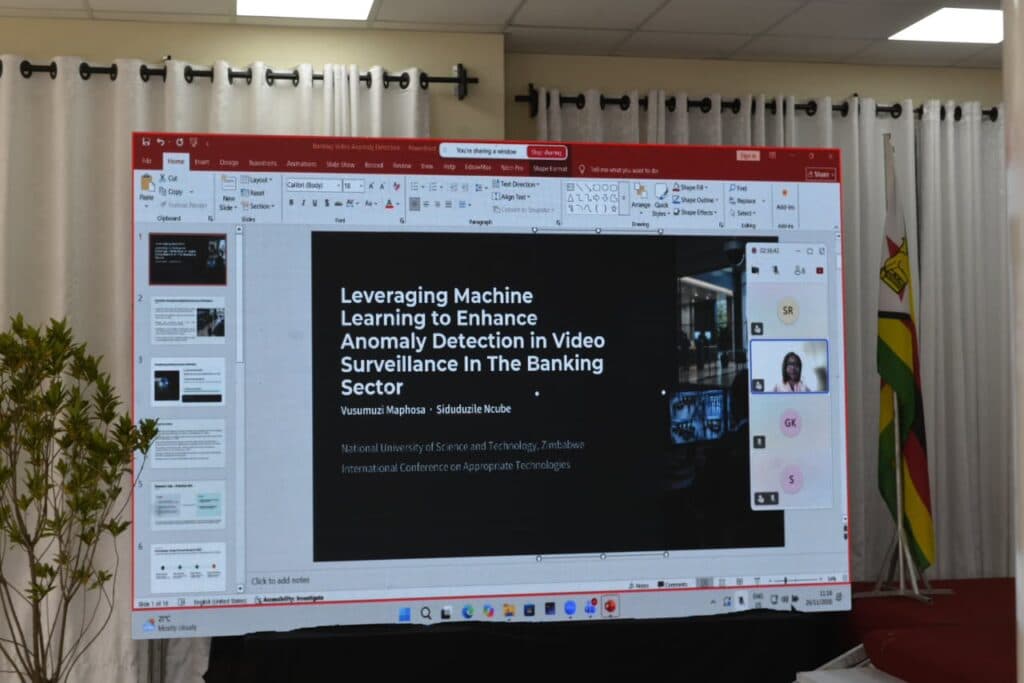
The prototype, developed by Vusumuzi Maphosa and Siduduzile Ncube, uses artificial intelligence to analyse CCTV footage and identify potential security threats, including unauthorised entry, ATM tampering, theft and unusual behaviour.
Presenting the research findings, NUST Director of Information and Communications Services Vusumuzi Maphosa said conventional CCTV systems often depend on security personnel continuously monitoring screens, making it difficult to identify suspicious incidents across large volumes of footage.
If successfully developed and implemented, the technology could help financial institutions improve security monitoring and respond more quickly to potential threats.
AI System Targets Multiple Security Threats
The research, titled Leveraging Machine Learning to Enhance Anomaly Detection in Video Surveillance in the Banking Sector, examines how machine learning can improve the speed and effectiveness of surveillance monitoring.
The prototype was trained to identify several forms of potentially suspicious activity, including:
- Unauthorised entry and intrusions.
- ATM tampering.
- Theft and movement of objects.
- Loitering near restricted areas.
- Suspicious gestures.
- Unusual crowd behaviour.
According to Maphosa, traditional surveillance systems can allow suspicious incidents to go unnoticed, while some generate false alarms that make it harder for security teams to distinguish genuine threats from normal activity.
The researchers said the new system can automatically flag unusual activity and notify security personnel, allowing them to investigate without relying entirely on someone watching CCTV screens.
Prototype Records Promising Test Results
The system was tested using surveillance footage collected from a banking environment.
The researchers reported a precision score of 0.91 and a recall score of 0.91, alongside an F1 score of 0.82. They also identified LightGBM and XGBoost as the best-performing classifiers among the models tested.
The system is also expected to support investigations by preserving surveillance footage that may be used as evidence and helping financial institutions meet security and regulatory requirements.
However, the reported results relate to the prototype's testing. Further assessment using larger datasets and longer periods of real-world operation is still recommended.
Technology Could Extend Beyond Banks
Although the research focuses on banking security, the developers believe similar systems could be adapted for other security-sensitive environments.
Potential applications include schools, hospitals, border posts, retail outlets and public transport facilities, where surveillance cameras produce large volumes of footage.
Maphosa said the technology could strengthen video analytics in institutions that need to identify potential security threats more quickly.
Infrastructure and Privacy Challenges Remain
Despite its potential, introducing the system in Zimbabwe could require significant investment.
The researchers identified ageing surveillance infrastructure, unreliable electricity, limited internet connectivity and the cost of high-performance computing resources as possible barriers to implementation.
Integrating the prototype with existing CCTV systems would also require customisation and testing to ensure compatibility and real-time performance.
The study further highlights privacy, ethical and data protection concerns that would need to be addressed before widespread adoption.
Researchers Call for Further Testing
The researchers recommend that banks consider integrating machine-learning systems into existing surveillance infrastructure to improve threat detection and response times.
They also propose that policymakers encourage data-sharing practices and standardised methods for identifying suspicious activity, while financial regulators consider how machine-learning technology could fit into security compliance frameworks.
Future research will focus on testing the system with larger datasets from different institutions, developing models that require fewer computing resources and evaluating performance over longer periods in operational banking environments.
The development highlights the growing role of artificial intelligence in security technology, although its practical impact will depend on further testing, investment and responsible implementation.
Sources & reporting
The Granite Post Zimbabwe verifies documents, interviews sources and checks official records before publication. Our editorial standards explain what we require before a story runs.
Read our editorial standardsRelated Articles



Join the discussion
Share your view.
No comments yet. Be the first.