
Taiwan Votes on Nuclear Power Revival as AI Boom Raises Fears Over Energy Security
 By Prosper Makunike8 min read
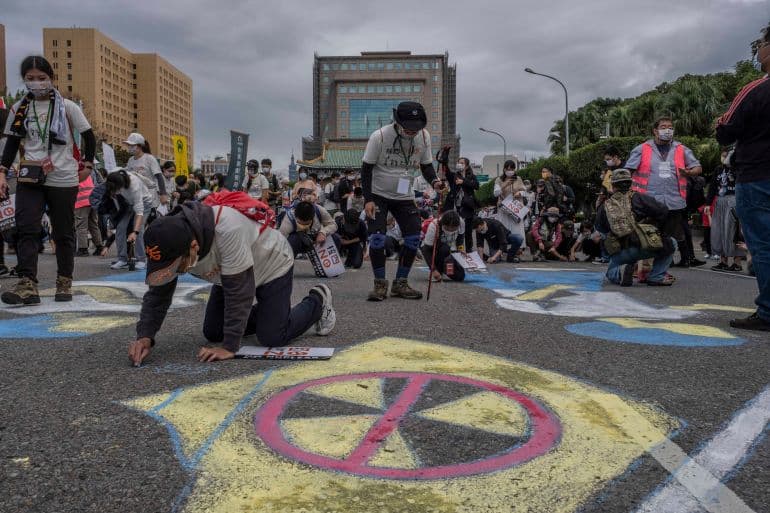
The vote comes 18 months after Taiwan shut down its last operational nuclear reactor and at a time when the island faces growing pressure to secure reliable electricity supplies for its expanding semiconductor and artificial intelligence industries.
The referendum is also taking place against the backdrop of rising tensions with China, which claims Taiwan as part of its territory. Concerns have increased over the possibility that a Chinese blockade could cut off vital energy imports and threaten the island's electricity supply.
The latest vote marks Taiwan's fourth referendum on nuclear power in eight years.
What Are Voters Being Asked to Decide?
The referendum asks whether Taiwan should abandon its long-standing nuclear-free homeland policy and allow nuclear power to return as part of its electricity generation strategy.
The proposal was initiated by the opposition Kuomintang (KMT), with support from the Taiwan People's Party (TPP). The legislature approved the referendum in August, followed by authorisation from the Central Election Commission on August 28.
For the proposal to pass, the number of votes supporting nuclear power must exceed those opposing it and represent more than 25 percent of all eligible voters.
The ruling Democratic Progressive Party (DPP), which has historically opposed nuclear energy, is campaigning for a "no" vote.
DPP legislator Chen Pei-yu has argued that the referendum is unnecessary because lawmakers could change the country's nuclear policy through amendments to existing legislation.
Taiwan's Long and Divisive Nuclear Energy Debate
Nuclear power once played a significant role in Taiwan's electricity production. In 1985, the country's three nuclear power stations generated approximately 52 percent of its electricity.
However, the issue gradually became one of the most politically divisive subjects in Taiwan.
According to Lev Nachman, an assistant professor at National Taiwan University's Graduate Institute of National Development, opposition to nuclear energy has deep historical roots within the DPP.
He explained that environmental activists were among the groups involved in establishing the party, while the country's nuclear industry had largely been developed under the KMT.
This history helped turn the nuclear debate into a political division between the traditionally green DPP and the blue KMT.
Safety concerns have also remained central to public opposition.
The 2011 Fukushima nuclear disaster in Japan intensified fears about the potential consequences of a major nuclear accident in Taiwan, where active geological fault lines increase concerns about seismic risks.
The disposal of radioactive waste remains another unresolved challenge.
The DPP came to power in 2016 with a commitment to phase out nuclear energy. That policy reached its final stage in May 2025 when the Maanshan nuclear power station in Pingtung County shut down its last operating reactor.
Previous Referendums Produced Mixed Results
Taiwan's earlier nuclear referendums have demonstrated how divided the population remains.
In 2018, voters supported removing a legal deadline that required the country to eliminate nuclear power.
However, a 2021 referendum seeking to restart construction of the unfinished Fourth Nuclear Power Plant was rejected.
In August 2025, another attempt to secure public support for restarting the Maanshan facility received majority backing among those who voted, but the result was invalidated because voter turnout was too low.
The latest referendum therefore represents another attempt to determine whether public attitudes towards nuclear energy have shifted.
Energy Security Becomes a Major Concern
Taiwan's dependence on imported energy has become an important factor in the renewed nuclear debate.
According to the Ministry of Economic Affairs, the island imports more than 97 percent of its energy requirements.
Natural gas accounts for approximately 43 percent of electricity generation, while coal contributes about 35 percent. Both fuels are transported into Taiwan by sea.
The country reportedly maintains only around 11 days' worth of liquefied natural gas reserves, compared with approximately 14 to 20 days in Japan and South Korea.
This dependence creates a vulnerability if shipping routes are disrupted.
Nachman identified energy security as one of the main reasons nuclear power has returned to the political agenda.
He warned that a Chinese blockade could prevent fuel shipments from reaching Taiwan, leaving the island dependent on its limited energy reserves.
The disruption of energy supplies linked to the war involving Iran has added further pressure by affecting LNG shipments from the Middle East.
Government Begins Exploring Nuclear Plant Restarts
Although the DPP continues to face internal resistance over nuclear energy, its position has begun to evolve.
In March 2026, President William Lai Ching-te announced that his administration would begin the process of restarting the Maanshan and Kuosheng nuclear power stations.
He cited increasing electricity requirements driven by artificial intelligence and the risks posed by international conflicts to energy supply chains.
On September 24, Taiwan's Nuclear Safety Commission approved state-owned electricity company Taipower's plan to restart the Maanshan facility.
However, additional safety assessments must still be completed before the plant can resume operations.
Nachman said Lai had been encouraging his party to reconsider what he described as its traditionally rigid opposition to nuclear power.
Nevertheless, the government continues to prioritise investment in liquefied natural gas as its main strategy for meeting future electricity demand.
Why the Vote Matters to the Global AI Industry
Taiwan occupies a central position in the global semiconductor industry and has become increasingly important to the development of artificial intelligence.
The island produces more than 90 percent of the world's most advanced semiconductors, with the majority manufactured by Taiwan Semiconductor Manufacturing Company (TSMC).
TSMC also controls more than 60 percent of the global contract chip manufacturing market.
Its major customers include Nvidia, AMD and Apple. The company manufactures Nvidia's Blackwell and Rubin AI processors, while Taiwanese manufacturers such as Foxconn and Quanta produce a significant proportion of the world's AI servers.
These operations require enormous quantities of electricity and water.
In September 2026, Taiwan's semiconductor industry consumed more than 4.5 billion kilowatt-hours of electricity for the first time, representing an 11.55 percent increase compared with the same period a year earlier.
The increase has been driven largely by growing demand associated with artificial intelligence.
Research by S&P Global estimated that TSMC alone consumed approximately eight percent of Taiwan's electricity in 2023. Its share could rise to nearly 24 percent by 2030 if demand continues to expand as projected.
Any prolonged disruption to Taiwan's electricity supply could therefore affect semiconductor production and potentially create consequences for technology companies and industries worldwide.
However, Nachman cautioned against viewing the referendum exclusively through the semiconductor industry.
He said energy security and the possibility of a Chinese blockade were equally important considerations for many Taiwanese citizens.
Does Nuclear Power Have Anything to Do With China's Military Ambitions?
The referendum concerns civilian nuclear electricity generation rather than the development of nuclear weapons.
Nachman dismissed suggestions that the vote was connected to Taiwan's pursuit of nuclear weapons, explaining that the issue was strictly about energy production.
Taiwan secretly pursued a nuclear weapons programme during the 1970s and 1980s, but the initiative was terminated in 1988 following pressure from the United States and the defection of senior nuclear scientist Chang Hsien-yi.
Since then, successive Taiwanese administrations have maintained that the island will not develop nuclear weapons.
Its nuclear facilities are subject to inspections under an arrangement involving Taiwan, the United States and the International Atomic Energy Agency.
China has not appeared to comment directly on the referendum, although Beijing has previously used Taiwan's dependence on imported energy as part of its political messaging.
In March 2026, Chen Binhua, spokesperson for China's Taiwan Affairs Office, suggested that closer integration with mainland China could help address the island's energy challenges.
Taipei rejects Beijing's unification ambitions.
Chinese President Xi Jinping reiterated his country's position on reunification during a speech in Beijing on November 12.
Analysts have also expressed concern that China's military exercises and naval patrols around Taiwan, which intensified following former US House Speaker Nancy Pelosi's visit in 2022, have included scenarios involving the isolation of the island.
Will Voters Support Nuclear Power?
Despite the growing debate, the referendum's outcome remains uncertain.
Nachman expressed caution about the prospects of the proposal succeeding, noting that previous attempts to secure public support for nuclear energy had failed to produce the required results.
He believes the position of DPP supporters could prove decisive, particularly whether voters traditionally opposed to nuclear energy have become more receptive to its use.
If the referendum passes, the government would have a clearer public mandate to proceed with nuclear energy policy changes.
However, the process of restarting the reactors is already underway, meaning the technical assessments are not entirely dependent on the referendum result.
How Long Would It Take to Restart the Reactors?
The timeline for restoring nuclear power remains disputed.
Supporters of the proposal believe the reactors could potentially return to operation within 18 months to three years.
Opponents argue that the process could take between five and 10 years and cost several hundred billion New Taiwan dollars.
The differences reflect disagreements over the complexity of safety assessments, necessary upgrades and the condition of facilities that have been shut down.
Results of the referendum are expected on Saturday night.
Beyond the immediate political outcome, the decision could shape Taiwan's energy strategy at a critical time for the global technology industry, as demand for AI computing continues to grow and concerns over the island's vulnerability to energy supply disruptions intensify.
Sources & reporting
The Granite Post Zimbabwe verifies documents, interviews sources and checks official records before publication. Our editorial standards explain what we require before a story runs.
Read our editorial standards
Related Articles

Join the discussion
Share your view.
No comments yet. Be the first.